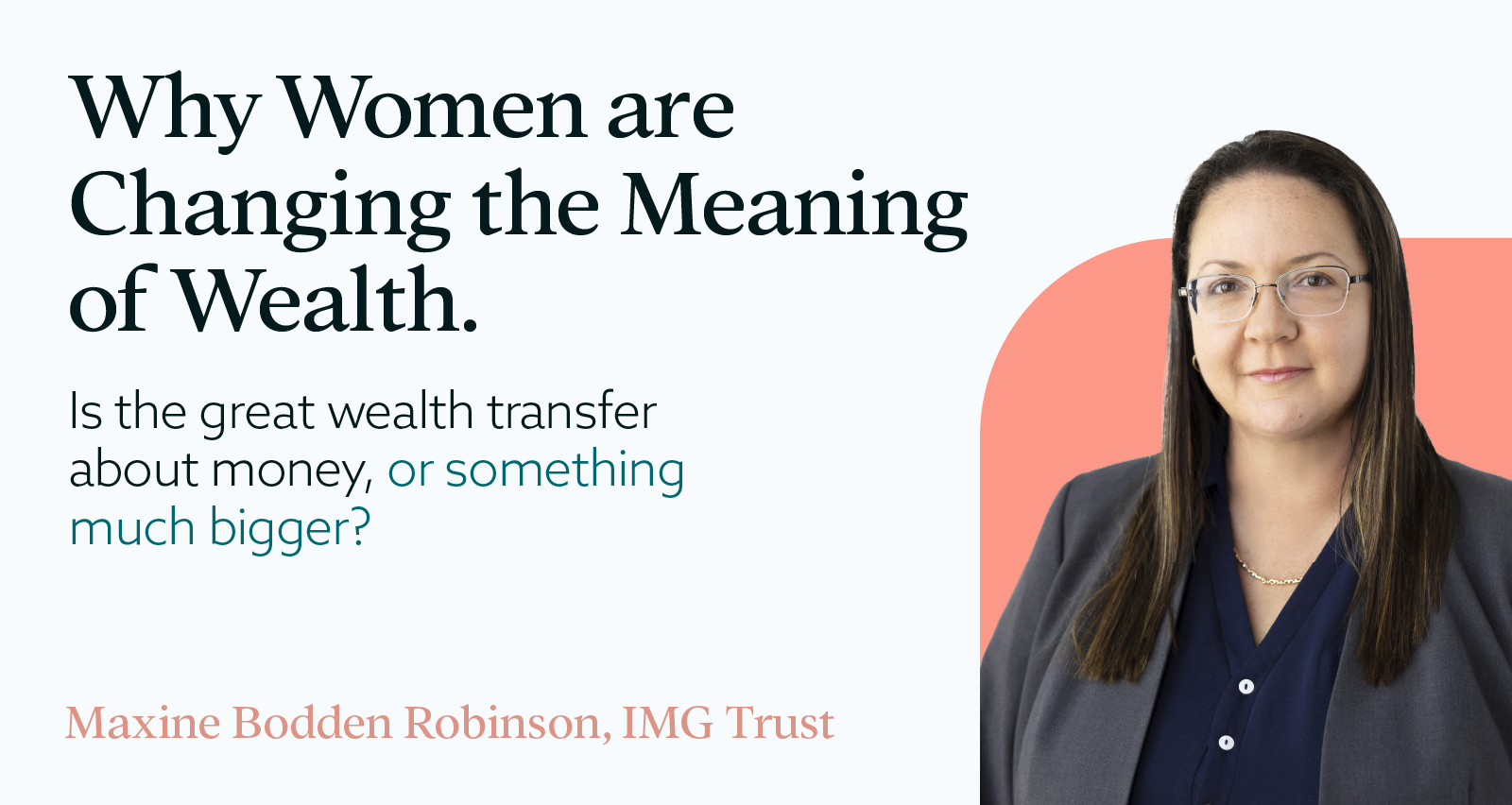
Maxine Bodden Robinson, Founder, IMG Trust
A very much underexplored area as most wealth writing still focuses on numbers rather than psychology, power structures, and cultural behavior. As a woman and a founder in the private wealth industry, I’m encouraged everyday by how women are reshaping capital allocation, privacy, luxury, family governance, and even definitions of success.
Articles about women tend to focus on women and money – budgeting, gender wealth gap, career interruptions, inheritance, retirement gaps. But the most consequential shift in women’s wealth is not just about numbers. It’s about influence, decision-making, and redefining what wealth means – it is structural.
Women are becoming the first generation in modern history to control significant pools of capital without needing to inherit social permission alongside it. That distinction changes everything. Women are not just participants in wealth; they are reshaping the definition of wealth.
For centuries, wealth held by women was usually supervised by a father, husband, family office, trustee, bank, dynasty, or institution designed by men. Even where women legally owned assets, the architecture of wealth itself — law, banking, taxation, inheritance, private markets, property rights, and elite networks was overwhelmingly male-coded.
Today, that architecture is lagging behind the reality of who now controls capital and the result is producing a new phenomenon almost nobody discusses:
Women are increasingly wealthy in systems psychologically and institutionally built for male patterns of power accumulation.
That mismatch is reshaping how capital behaves. As women increasingly control wealth — through entrepreneurship, inheritance, executive compensation, investing, and family office influence — capital is beginning to move differently.
Wealth Is No Longer Only About Ownership
Historically, wealth was designed around permanence, preserving dynasties, consolidating land, maintaining industrial control, signaling hierarchy.
The old wealth model rewarded concentration, inheritance, institutional loyalty, and emotional detachment from capital.
But many affluent women — especially first-generation wealth creators — interact with capital differently.
Research consistently shows women often hold more liquidity, diversify earlier, avoid overleveraging, invest with longer horizons and prioritize resilience over dominance.
Yet the deeper distinction is cultural, not behavioral. Many women do not see wealth as identity completion.
Men have historically been socialized to become wealth. Women are more often socialized to manage relationships around wealth.
That changes risk appetite, succession planning, philanthropy, consumption patterns, and even luxury markets. The rise of women in wealth is not just a demographic trend—it’s a cultural transformation. As women gain financial power, they are investing in communities, funding women-led ventures driving philanthropic and impact investing and shaping financial education for the next generation.
This shift is creating a more inclusive, sustainable and socially conscious financial landscape.
The Real but Invisible Labour Behind Male Wealth
One of the least discussed truths in private wealth is this:
A tremendous amount of male wealth historically depended on invisible female stability. Not necessarily through direct financial contribution, but through social management, emotional regulation, reputation maintenance, caregiving infrastructure and intergenerational continuity.
The “great businessman” archetype often rested on unpaid systems of domestic continuity that enabled uninterrupted risk-taking.
Now women are simultaneously earning capital, managing households, investing, caregiving, building businesses, maintaining social infrastructure.
Which means women frequently experience wealth not as freedom — but as compression. That is why many wealthy women report exhaustion rather than triumph. The emotional burden of wealth has shifted faster than the institutional support around it.
Women Are Quietly Redefining Prestige
Luxury industries still market heavily toward traditional status signaling bigger yachts, louder watches, visible consumption, scarcity displays.
But among many affluent women, prestige is becoming increasingly linked to:
- optionality,
- privacy,
- mobility,
- health,
- time autonomy,
- geographic flexibility,
- freedom from dependence.
The new status symbol is not necessarily ownership. It is frictionless control over one’s life. That shift matters economically because luxury markets evolve around female purchasing behavior faster than analysts admit.
We are already seeing movement from:
- conspicuous consumption → curated utility,
- ownership → access,
- display → discretion,
- scale → flexibility.
The next decade of wealth industries may look less like dynastic banking and more like lifestyle infrastructure:
- education portability,
- cross-border residency,
- secure digital identity,
- family governance,
- asset mobility,
- private communities,
- emotional wellness services for high performers.
Not because women are softer or less savvy investors. Because their definition of wealth utility is broader.
The Coming Transfer No One Fully Understands
The often-cited “great wealth transfer” understates what is actually happening. This is not simply money moving from the older generation to the younger or from men to women. It is capital moving from one philosophy of wealth to another.
Over the next two decades, women are expected to control unprecedented levels of global private wealth through entrepreneurship, divorce settlements, executive compensation, inheritance, widowhood, and investment growth.
But the institutions managing wealth still largely assume linear careers, traditional marriages, male succession norms, nuclear family structures, and domestically anchored lives.
Many wealthy women live outside those assumptions entirely. They are single by choice, cross-border, have blended families, entrepreneurial, digitally native and still manage to care for both children and parents simultaneously.
The future client profile of wealth management is being misunderstood because the future client does not resemble the historical template wealth institutions were designed around.
Women Are Beginning to Treat Wealth as Infrastructure, Not Validation
Historically, wealth often functioned as proof of intelligence, proof of masculinity, proof of status, and proof of victory.
Increasingly, many women are treating wealth more pragmatically as protection, as mobility, as leverage against vulnerability, as sovereignty.
That orientation changes financial decision-making profoundly. Someone seeking validation spends differently than someone seeking autonomy.
One accumulates symbols. The other accumulates negotiating power. And negotiating power is quieter.
It may look like:
- liquid reserves,
- owning rather than renting office space,
- trusts,
- education capital,
- community networks,
- low visibility wealth,
- jurisdictional diversification,
- debt avoidance,
- time flexibility.
The future of wealth may therefore become less performative and more strategic.
Women are not simply entering the existing wealth system. They are changing the emotional meaning of wealth itself.
Women are reshaping capital allocation not simply because they control more money than before, but because many are deploying capital according to different priorities, risk frameworks, and definitions of value.
The important shift is not women entering finance. It is different philosophies entering finance through women.
Read more about Maxine HERE